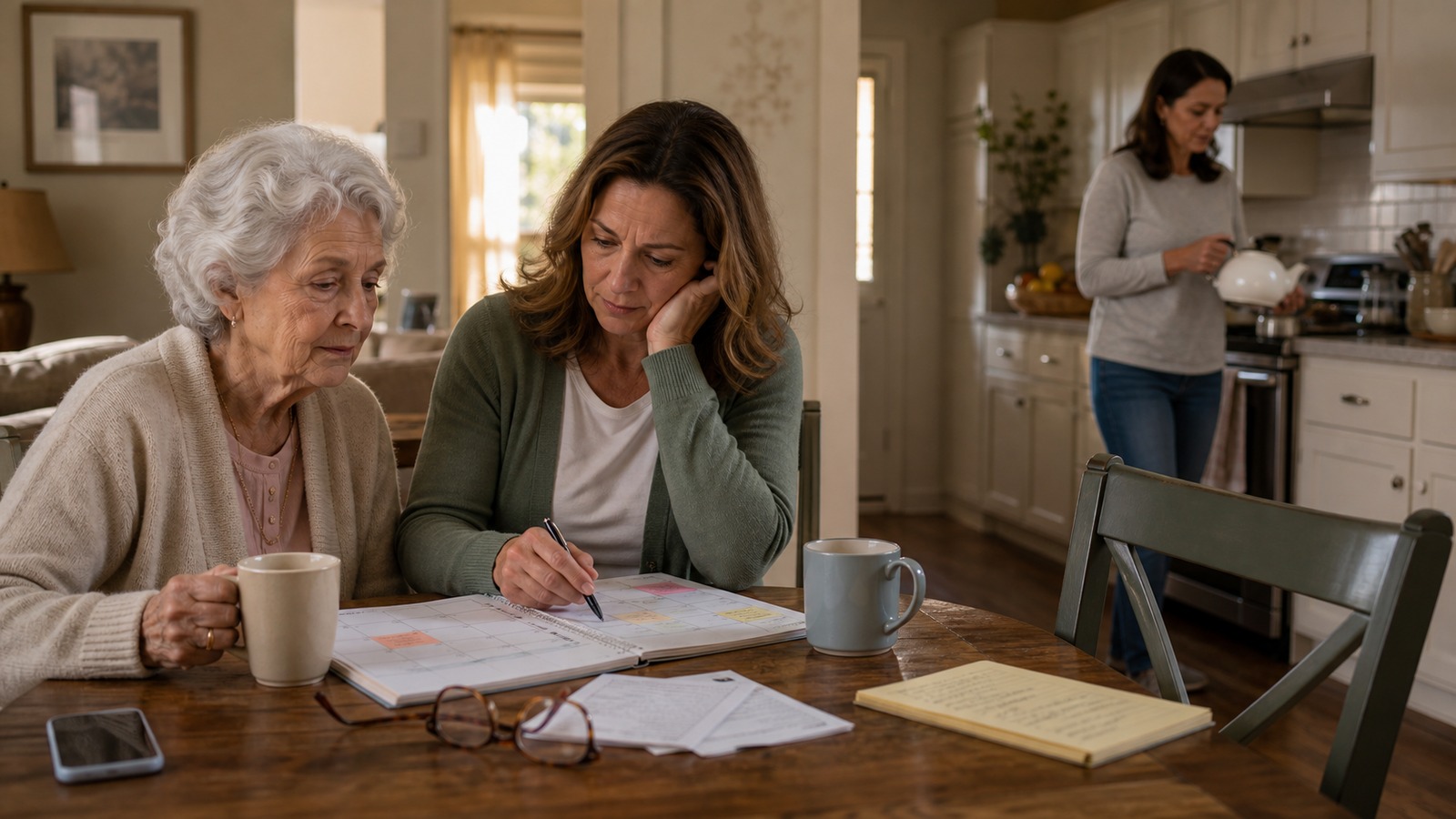

Many families struggle with timing. Move too early and it can feel premature. Move too late and decisions happen during a crisis. The goal is to decide when support needs clearly exceed what home routines can provide safely and consistently.
This article gives a practical question set you can use to make that call with more confidence.
Start with the right decision lens
The key question is not whether your loved one can do some things independently. The key question is whether daily safety, health routines, and quality of life are reliable without constant emergency-level effort from family.
Key questions families should ask
1) Is home still consistently safe?
Look at falls, medication misses, wandering, kitchen incidents, and emergency calls over the last 60 to 90 days.
2) Are daily living routines stable?
Can your loved one consistently manage hygiene, meals, hydration, mobility, and appointments?
3) Is cognitive change affecting judgment?
Memory decline, confusion, and poor risk awareness are common triggers for moving to a more supervised setting.
4) Is caregiver strain sustainable?
If family caregivers are losing sleep, missing work, and operating in constant crisis mode, the care model needs to change.
5) Are social and emotional needs being met?
Isolation and inactivity can worsen health outcomes. Community-based support can improve engagement and emotional stability.
When the answer is usually "yes, it is time"
- Safety events are becoming frequent.
- Care needs are rising faster than family can manage.
- Medical routines are no longer reliable at home.
- Caregiver burnout is affecting everyone's health.
How to decide without rushing
- Document incidents and unmet care needs in writing.
- Set non-negotiables: safety, dignity, communication, and budget.
- Tour 3 communities and ask identical questions.
- Review full monthly cost scenarios, not just entry pricing.
- Choose the option that gives stable care now and scales with future needs.
Common mistakes to avoid
- Waiting for a hospitalization or major fall to force the decision.
- Choosing based on amenities while underweighting care execution.
- Skipping second visits and evening/weekend observations.
- Ignoring long-term care-level cost progression.
Final takeaway
Senior living is "right" when it improves safety, daily consistency, and dignity for the resident while restoring sustainability for the family. A structured evaluation process removes guesswork and improves outcomes.
Related resources: Services, Contact, All Blogs, DeSoto, Plano, Waxahachie.