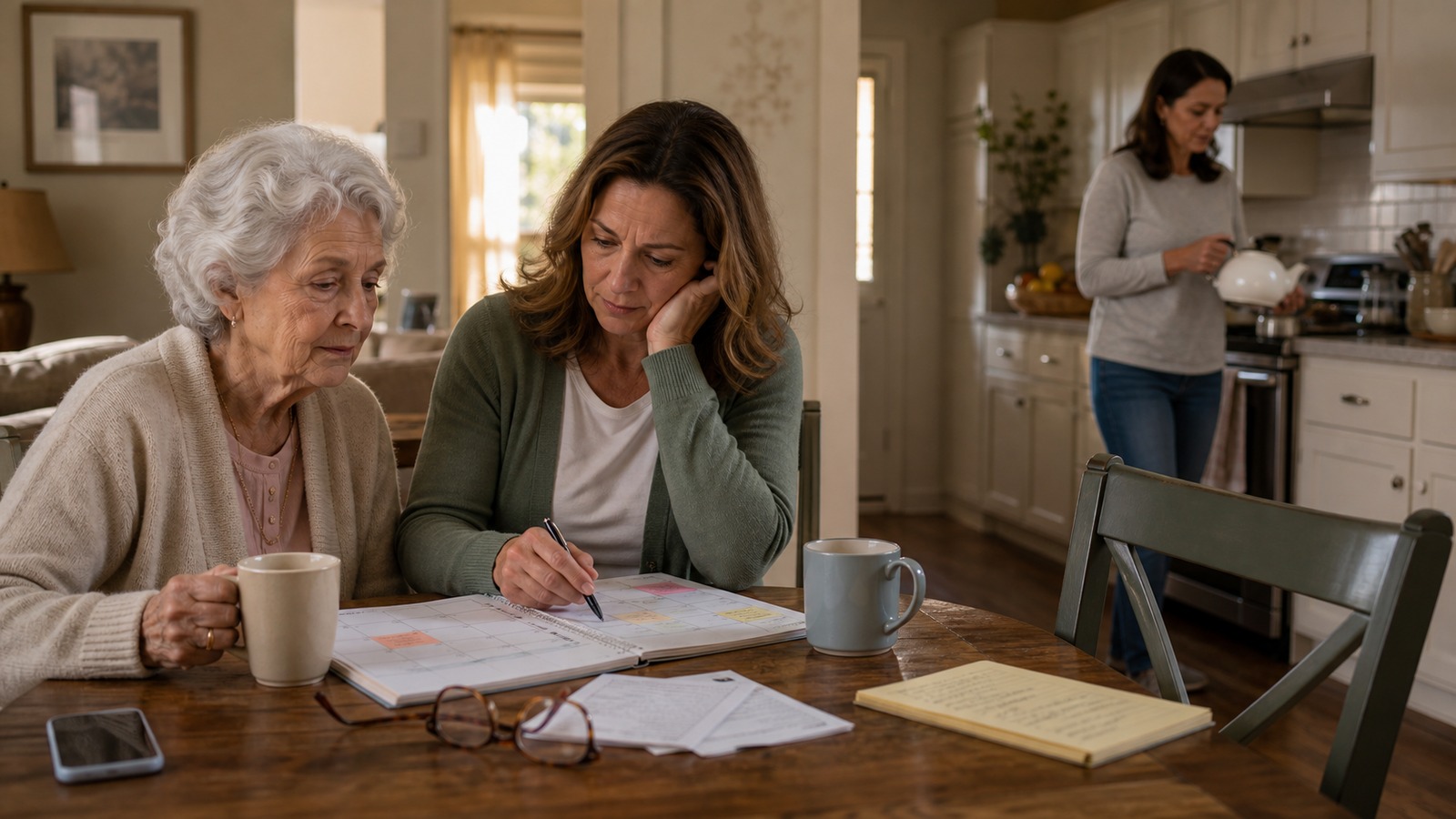
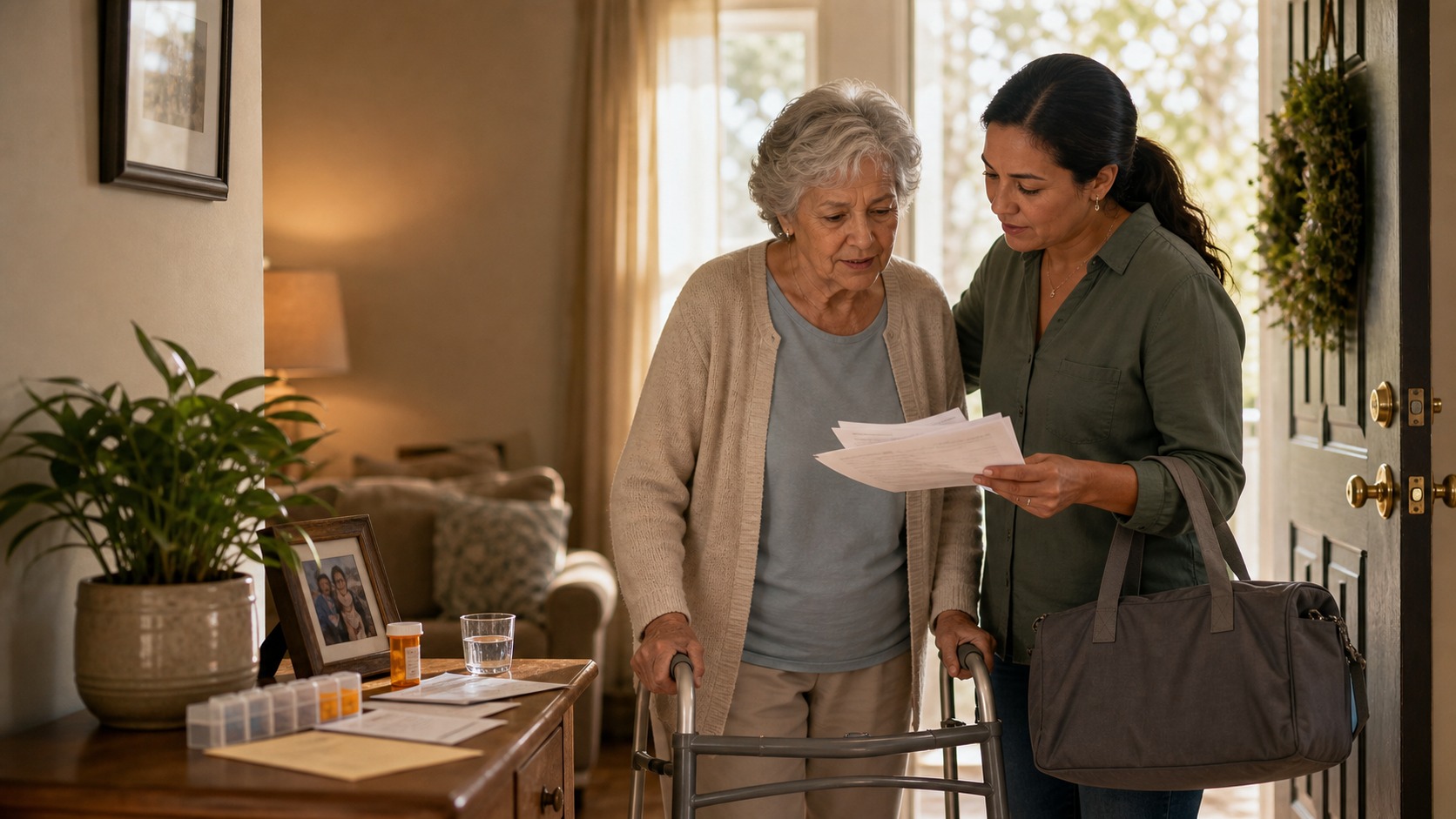
A hospital discharge can feel like good news and a new worry at the same time.
Your loved one is no longer in the hospital. That is a relief. But now the family is handed instructions, medication changes, follow-up appointments, therapy recommendations, equipment needs, diet notes, warning signs, and a question nobody says out loud clearly enough: can they really manage at home?
For many families, the first few weeks after a hospital stay reveal what was hard to see before. Mom may be weaker than she was before the fall. Dad may understand the discharge instructions in the hospital, then feel confused once he is back in his own kitchen. A loved one may say they are fine, but meals, bathing, medication timing, walking, sleep, and follow-up appointments suddenly take more effort than expected.
This does not mean every hospital stay should lead to assisted living. Many older adults recover well at home with the right support. But a hospital-to-home transition is one of the moments when families should look closely and honestly at daily life.
Discharge is not the same as being fully back to normal
Families often hear that a loved one is "ready to go home" and assume the person is ready to resume their old routine. Those are not always the same thing.
A hospital may determine that a person no longer needs hospital-level care. That does not automatically mean they can safely shop, cook, bathe, manage medications, walk to the bathroom at night, keep up with appointments, and recover alone.
The Medicare discharge planning checklist encourages patients and families to ask about the kind of help needed after discharge, including medicines, equipment, follow-up care, and whether support is needed at home. That is the right mindset. Discharge should begin a practical plan, not end the conversation.
Why the first weeks home matter
The days after discharge can be confusing because everything changes at once. There may be new medications, stopped medications, new instructions, new physical limits, new appointments, and a new fear of another emergency.
The AHRQ Patient Safety Network describes discharge planning and transitions of care as challenging because patients and families often become responsible for coordinating care after leaving the hospital. That coordination can be especially hard for older adults with multiple conditions, memory changes, weakness, limited transportation, or family support that is stretched thin.
At home, the real test becomes ordinary life. Can the person get from bed to bathroom safely? Can they prepare food? Are they taking medications correctly? Are they drinking enough? Are they sleeping in a chair because the bed feels too hard to reach? Are they avoiding the shower? Are they too tired to move much? Are family members calling constantly but still unsure what is happening?
Those daily answers matter.
What families should watch for after discharge
Families should avoid panic, but they should also avoid wishful thinking. The goal is to notice patterns early.
Pay attention to:
- New weakness or fatigue that makes normal tasks difficult.
- Confusion about discharge instructions or follow-up appointments.
- Medication bottles that do not match the discharge list.
- Missed meals, low appetite, or not drinking enough fluids.
- Fear of walking, showering, or getting up at night.
- Falls, near falls, dizziness, or holding furniture while walking.
- Not using a walker, cane, brace, or other recommended equipment.
- Unwashed clothes, skipped bathing, or less attention to personal care.
- Family members feeling they need to check in many times a day.
- A loved one saying "I am fine" while clearly doing less than before.
These signs do not automatically mean assisted living is required. They do mean the care plan needs a closer look.
Medication changes deserve special attention
Hospital stays often lead to medication changes. A dose may change. A new medication may be added. An old medication may be stopped. A temporary medication may be prescribed. Instructions may depend on food, timing, symptoms, or follow-up lab work.
The FDA's medication safety guidance for older adults encourages keeping an updated medicine list, following directions, understanding side effects, and asking healthcare professionals before making changes. After discharge, that advice becomes especially important.
Families should compare the discharge medication list with the bottles at home. If anything is unclear, call the prescribing clinician or pharmacist. Do not guess, restart old medications, stop new medications, or combine old and new instructions without professional guidance.
This article is educational and is not medical advice. Medication questions should always go to a qualified healthcare professional.
Falls can become more likely after a setback
Many older adults leave the hospital weaker than they were before. Even a short stay can disrupt sleep, movement, appetite, confidence, and strength. If the hospital stay followed a fall, infection, surgery, dizziness, dehydration, or a medication issue, families should be especially alert.
The CDC's fall prevention guidance emphasizes practical steps such as talking with a healthcare provider, reviewing medicines, checking vision and feet, staying active when appropriate, and making the home safer. After discharge, families can use that guidance to ask better questions.
Look at the home with fresh eyes. Are there loose rugs? Poor hallway lighting? A bathroom that now feels unsafe? Stairs that are harder than before? A bed that is too high? A walker that does not fit through tight spaces? A favorite chair that is hard to stand from?
A home that worked before the hospital stay may not work the same way afterward.
Discharge instructions need a real-life plan
Good discharge planning is more than paperwork. AHRQ's Re-Engineered Discharge toolkit focuses on improving discharge processes so patients leave with clearer plans and better follow-up. For families, the practical lesson is simple: clarity matters.
Before or soon after discharge, families should try to answer:
- What changed during the hospital stay?
- What medications are new, changed, or stopped?
- What symptoms should prompt a call to the doctor?
- What symptoms should prompt emergency help?
- What appointments are already scheduled?
- Who is arranging transportation?
- Is therapy recommended?
- Is special equipment needed?
- Can the person bathe, dress, eat, and move safely at home?
- Who is checking in each day?
If the answer to several of these questions is "we are not sure," the family may need more support before the situation becomes urgent.
When home support may be enough
Some older adults can return home safely with the right plan. That may include family visits, home health services when ordered and appropriate, therapy, meal help, medication organization, transportation, home safety changes, and regular follow-up with healthcare professionals.
Home may still be reasonable when:
- The person understands the care plan or has reliable help with it.
- Family or caregivers can respond consistently.
- Meals, hydration, bathing, and medications are manageable.
- The home environment can be made safer.
- Follow-up appointments are realistic to attend.
- The older adult is improving week by week.
The key phrase is "with the right plan." Hope is not a plan. A calendar, medication list, transportation plan, safety changes, and clear family roles are a plan.
When the hospital stay points to a bigger care conversation
Sometimes the hospital stay does not create the care concern. It reveals it.
It may be time to consider assisted living or another more supported setting if:
- Your loved one cannot safely manage the day without frequent help.
- Family members are taking turns checking in but still feel uneasy.
- Medication changes are too complex to manage alone.
- Meals, bathing, dressing, or toileting have become inconsistent.
- There are repeated falls, near falls, or emergency calls.
- Discharge instructions are not being followed because the routine is too hard.
- The person is isolated, fearful, or mostly sitting to avoid risk.
- The family caregiver is exhausted before recovery has even started.
Assisted living is not a failure of the family. It can be a way to make daily life more supported, more consistent, and less dependent on crisis management.
What assisted living can add after a hospital stay
MedlinePlus describes assisted living as housing for people who need help with daily care but do not need the level of medical care provided in a nursing home. That distinction matters. Assisted living is not a hospital and does not replace physicians, nurses, therapists, or pharmacists. But it can support the daily routines that help an older adult stay more steady.
Depending on the resident's needs, care plan, and state rules, assisted living may help with:
- Regular meals and hydration routines.
- Medication reminders or medication support within allowed scope.
- Personal care such as bathing, dressing, and grooming.
- Observation when appetite, mood, movement, or energy changes.
- Communication with family when something seems different.
- A safer daily rhythm with people nearby.
- Less isolation during recovery.
The value is not only that help exists. The value is that the day has structure.
Questions families can ask before deciding
If your loved one has recently been discharged, ask practical questions. Keep the tone respectful. The goal is not to prove they cannot live alone. The goal is to understand what support is actually needed.
Ask:
- What feels harder now than before the hospital stay?
- Do you feel safe walking to the bathroom at night?
- Are you comfortable showering alone?
- Do the medication instructions make sense?
- Are you eating enough to keep your strength up?
- Who is taking you to follow-up appointments?
- Are you afraid of falling again?
- Would a little more daily support help you recover with less stress?
- What would make home feel safer right now?
- At what point should we talk about a more supported setting?
These questions can be hard, but they are better than waiting until the next crisis answers for everyone.
How A Place Called Home thinks about recovery and daily support
A Place Called Home was created for families who want care that feels personal, calm, and familiar. Our licensed DeSoto assisted living home is intentionally small, which helps caregivers learn each resident's routines, preferences, and normal daily patterns.
After a hospital stay, those patterns matter. Is someone eating less? Moving differently? Sleeping more? Avoiding bathing? Needing more reminders? Looking worried? In a smaller home setting, these changes can be easier to notice and communicate.
For families in DeSoto, Duncanville, Cedar Hill, Lancaster, Red Oak, and nearby communities, the first weeks after discharge can be the moment when everyone realizes home needs more help than it used to.
If your loved one recently came home from the hospital and the family is unsure whether the current plan is enough, it may be time for a calm conversation about daily support.
The bottom line
A hospital discharge is not the finish line. For many older adults, it is the beginning of a vulnerable transition back into daily life.
The first weeks home can reveal whether the current support system is strong enough. Watch meals, movement, medications, bathing, appointments, mood, sleep, and family strain. Ask better questions. Involve healthcare professionals. Make the home safer when possible. And be honest if home no longer has enough help around it.
To learn more, visit our services, read about our DeSoto assisted living home, or contact A Place Called Home to talk through your family's needs.